I’ve launched a new mini-SaaS called PeriPost, which is a little tool for sharing existing website content on social platforms via X and Bluesky by reading your existing RSS feed or XML sitemap.
I run several blogs and websites (e.g. EastAsiaStudent, NotesToSelf, ChineseBoost) with that kind of content. Previously I would try to post my content on social platforms whenever I remembered. PeriPost is intended to help with that so that I don’t have to remember to manually post my content to the relevant social platforms and keep track of what I’ve posted where.
To automate social posting with PeriPost, the general steps are:
- Add an RSS feed and/or XML sitemap as a source
- Create a Queue reading from that source
- Connect a social account and point the Queue at the social account
The Queue is the central piece that connects things together in PeriPost. Any number of sources can feed into a Queue, and a Queue can post out to any number of connected social accounts.
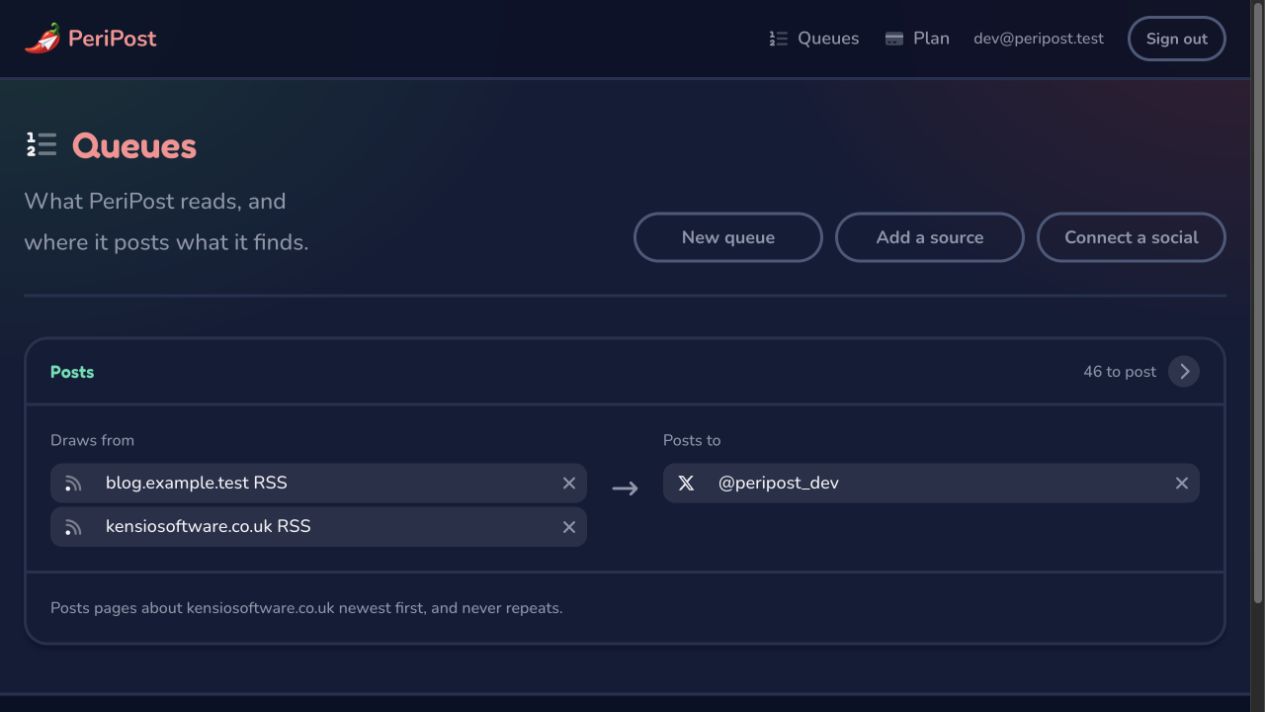
You also configure most of the settings on a Queue, such as filters and ordering, as well as the posting schedule.
PeriPost keeps track of what is available from the sources and what has been posted to the connected social accounts. If multiple sources for one Queue contain duplicate entries for the same post, that still only ends up as one output post because posts are tracked at the Queue level and not at the source level.
By default a Queue starts with the newest posts and skips anything already marked as posted. You can reconfigure that to go through older articles first, or to randomise the ordering, which can be more interesting for some kinds of content.
PeriPost takes whatever meta information is available in the HTML on the pages themselves, so things
like meta title, meta description, various og: tags like og:description, as well as the various
twitter: tags such as twitter:card.
There’s a free tier, which includes the sourcing and ordering etc, you just have to click a button on a post in the PeriPost UI to manually post it to a social platform yourself.
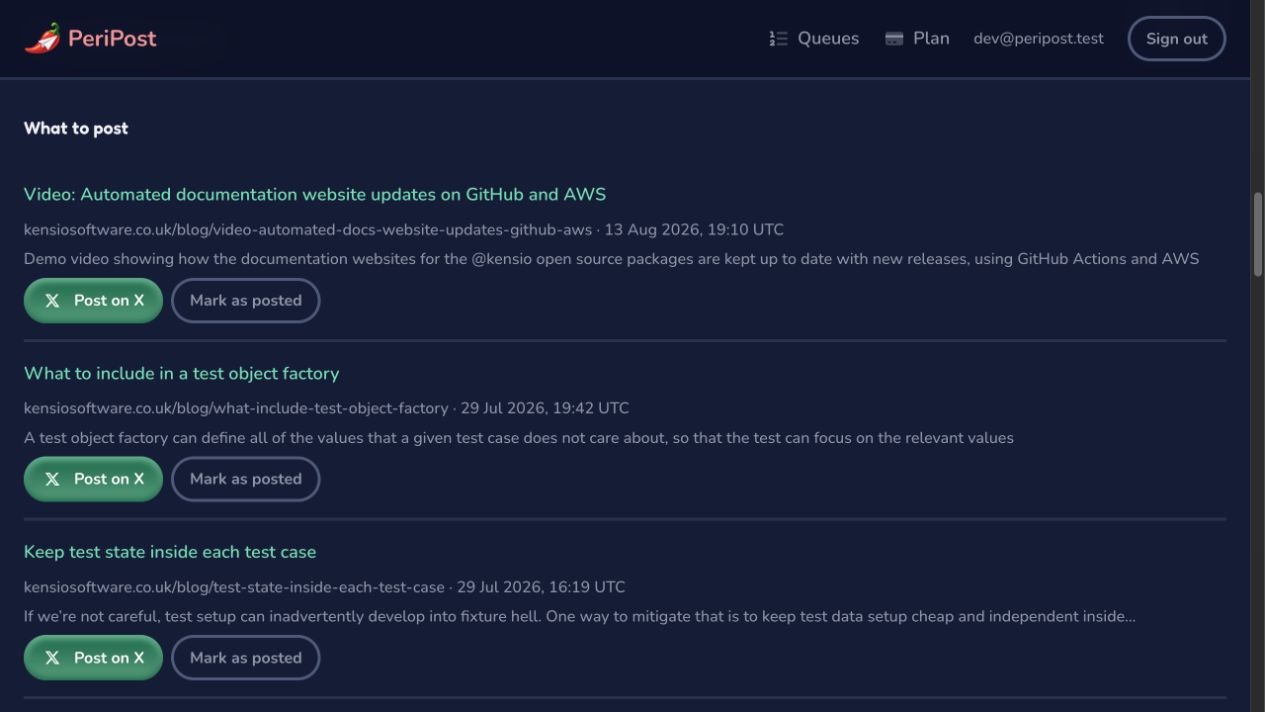
Currently there are two paid tiers with differing levels of included automated posting. Both paid tiers automatically keep track of what has been posted.
The web app is written in TypeScript and runs on AWS. Its tests deploy the CDK templates into Yulin AWS simulator and use Simnaril to simulate the external service APIs.